
It is the end of a good year. You ran eleven jobs, you won more than you lost, and when your bookkeeper hands you the profit-and-loss it says you made money. Real money. So why did you move payroll to a credit card in August, float the lumber package on your own line of credit in September, and lie awake in October doing math on a napkin? You are not bad at this. The job was profitable. The problem is that profit and cash are two different things, and nobody warns a builder that you can run a healthy business straight into an empty bank account.
Here is the short version. A job can be profitable and still bleed you dry, because profit is what you earn over the whole project and cash is what you have in hand on any given Tuesday. Money leaves your account early, in deposits to suppliers, payroll, and sub mobilization, and it comes back late, in draws that lag your costs, change orders you bill at the end, and retainage that sits for months after the work is done. That gap is the cash-flow gap, and when it gets wide enough you end up financing the homeowner’s project with your own money. The fix is not more sales. It is a billing system that pulls cash in before it goes out: a real deposit, a draw schedule tied to milestones, change orders billed the week they happen, tight terms with your subs, same-day invoicing, and retainage you actually chase down. This post walks all seven stages, hands you the exact messages that get you paid, and shows how it changes at three sizes of shop.
In this post
- Profit is a story, cash is the truth
- What the cash-flow gap actually costs you
- The seven stages where cash enters and leaves a job
- Stage by stage: how to keep a job cash-positive
- Steal this: the money messages that get you paid
- What the system looks like at three sizes
- The legal lines around deposits, liens, and retainage
- Common objections
- Frequently asked questions
- Sources
Profit is a story, cash is the truth
Profit is an accounting idea. It is the number you get when you add up everything a job earned and subtract everything it cost, spread across the whole project. Cash is physical. It is the balance in your account on the day payroll runs. The two numbers almost never match on any given week, and the whole trap lives in that gap.
Picture a $200,000 remodel that will net you a clean 9 percent, so $18,000 in profit. Good job. Now walk the calendar instead of the ledger. Week one you put $12,000 down on cabinets and windows so they are not late. Week two you cover framing payroll and a deposit to your plumber. Week three the homeowner’s first draw finally clears, but it only covers work you already paid for two weeks ago. You are not losing money on the job. You are lending money to the job. And you keep lending until the draws catch up, which on a slow-paying project they never quite do.
This is why builders who are busy and winning still get squeezed. Growth makes it worse, not better. A second and third job running at the same time means two or three sets of early costs stacked on top of each other, all going out before any of the draws come back. More volume widens the gap. That is the opposite of what your gut tells you, and it is why a great year can end with a maxed-out credit line.
The cruel part is that the money is real and it is yours. It is just sitting in the future, in a draw that has not been requested, a change order nobody billed, or a retainage check that will not release until the last punch-list item is signed off. The job is not unprofitable. The cash is just arriving in the wrong order. Fix the order and the same job that drained you can fund itself.
What the cash-flow gap actually costs you
Slow money is not a minor annoyance in this trade. It is a multi-billion-dollar structural feature of it. Rabbet’s 2024 Construction Payments Report estimated that slow payments cost the US construction industry around $280 billion in a single year, roughly 14 percent of all construction spending, and found that 82 percent of contractors were waiting more than 30 days to get paid, up sharply from 49 percent two years earlier (Rabbet, 2024). When the whole industry runs on late money, the builder without a billing system is the one who absorbs the delay out of pocket.
The clock backs that up. Construction carries some of the longest days-to-get-paid of any industry, with estimates for average days sales outstanding landing somewhere between 60 and 90 days once you count retainage, well above the roughly 60-day cross-industry average (Projul, 2024). Every one of those days is a day your money is funding someone else’s project. On a six-figure job, that is real interest you are paying, or real opportunity you are missing, whether or not it ever shows up on the P&L.
The cost shows up three ways. First, direct interest: every dollar you float on a credit card or a line of credit carries a rate, and on a thin-margin job the finance charges can eat a visible slice of your profit. Second, missed work: cash tied up in a slow-paying job is cash you cannot use to mobilize the next one, so you turn down or delay good work because you are short, not because you are busy. Third, and worst, panic decisions: a builder who is short on cash takes the wrong job, skips the deposit to keep a nervous client happy, or pays a sub late and loses them. None of those are margin problems. They are timing problems wearing a margin costume.
Rough average days sales outstanding, construction versus the cross-industry average, from 2024 industry estimates (Projul). Construction waits longer to get paid than almost anyone, and retainage is a big part of why. Treat these as directional benchmarks, since figures move with how each source counts retainage.
The point is not to scare you. It is to name the thing. If you have ever been profitable and broke at the same time, you were not imagining it and you were not mismanaging the business. You were absorbing a timing gap that the trade builds into every job. Now let us close it.
The seven stages where cash enters and leaves a job
A construction job is really a sequence of cash events. Money comes in at a few points and goes out at many. If you map those points and bill against them on purpose, the account stays positive. If you let them happen to you, the account goes underwater in the middle of every project. Here are the seven stages where the money moves, and the next section works each one.
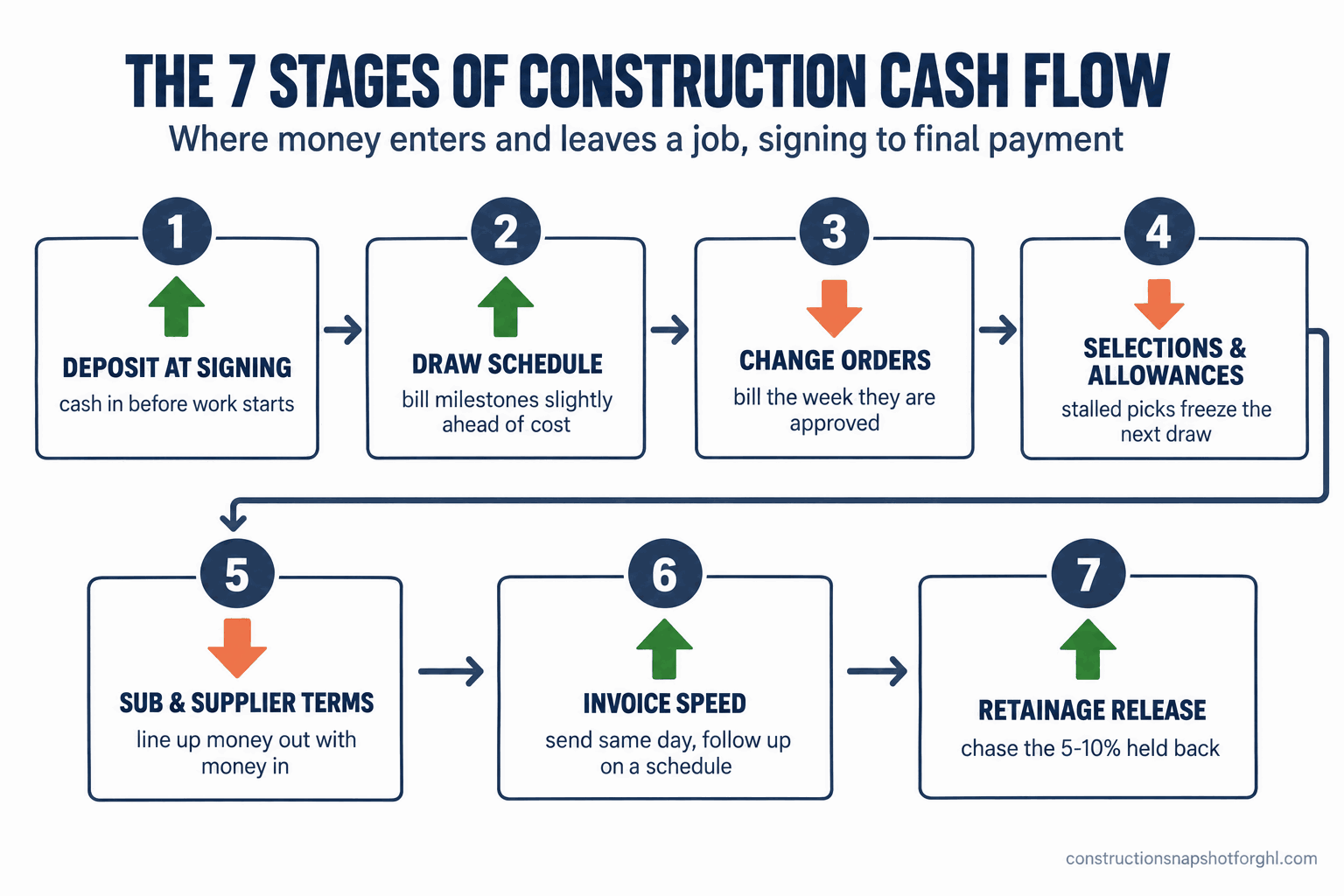
Think of it as a path, not a pile. Stage one and two are about getting cash in the door before and as costs hit. Stages three through five are about not letting cash leak out ahead of what comes in. Stages six and seven are about pulling in the money you already earned but have not collected. Most builders are fine at the work and leak at every one of these seven points, because nobody ever taught them to treat billing as its own job on the jobsite.
Stage by stage: how to keep a job cash-positive
Stage 1: The deposit at signing. This is the single biggest lever, and the one builders cave on most. A real deposit, enough to cover your early material orders and first mobilization, means you start the job with the homeowner’s money instead of your own. Skip it, or take a token few hundred dollars, and you are funding week one out of pocket before a single draw exists. How it breaks: a nervous client pushes back, you want the job, so you agree to a tiny deposit and tell yourself the first draw will catch up. It never does, because now every draw is one step behind. The fix is a deposit sized to your real up-front costs, written into the contract, and explained as a material and scheduling deposit, not a favor. Put the number in the agreement before anyone signs, so it is policy, not a negotiation.
Stage 2: The draw schedule tied to milestones. After the deposit, your draw schedule is the engine that keeps cash flowing in. The goal is simple: bill at milestones that land slightly ahead of your costs, not behind them. Tie each draw to a visible, verifiable stage (demo complete, rough-in passed, drywall hung) so the homeowner can see what they are paying for and you are never waiting on a vague percentage. We lay out a full phase-by-phase structure in our construction draw schedule template. How it breaks: you set draws by calendar date instead of milestone, or you back-load them so the big money comes at the end. Then a two-week weather delay or a slow inspector pushes your draw while your costs keep marching, and the gap opens. The fix is milestone-based draws, front-weighted enough to stay ahead of spend, requested the day the milestone is hit and not a week later.
Stage 3: Change orders billed in real time. A change order is work you are financing until you bill for it, and most builders bill for it at the very end, if at all. On a job with eight to twelve scope changes, that is thousands of dollars of your money loaned to the client interest-free for months. How it breaks: the crew does the extra work on a handshake, the paperwork piles up, and you reconcile it all at closeout when the client is least happy to see a surprise bill. The fix is a 48-hour rule: price it, get it signed, and bill it the same week it is approved, so the cash comes in while the work is fresh and agreed. The signing half of this is its own skill, and we cover it in how to get change orders signed without a fight. Billed live, change orders become a cash-flow helper. Billed late, they are the single most common reason a profitable job runs dry.
Stage 4: Selections and allowances that stall the draw. This one surprises people, because it feels like a scheduling issue, not a cash issue. But a stalled selection freezes the milestone behind it, and a frozen milestone freezes your next draw. If the client cannot pick tile for three weeks, the bathroom cannot progress, the draw tied to that phase cannot be requested, and your costs on everything else keep running. How it breaks: you let selection deadlines float because you do not want to nag, and every slow decision quietly pushes a draw into next month. The fix is a selections schedule with hard dates tied to the draw calendar, so the client understands that a late pick does not just delay the finish, it delays a payment. Our selections process guide turns this into a system clients actually follow.
Stage 5: Sub and supplier terms that line up with your draws. Cash flow is about timing on both sides, not just what comes in. If your suppliers want net-15 and your draws land on net-30, you are underwater by design for fifteen days on every cycle. How it breaks: you accept whatever terms the supplier offers and never connect them to when your own money arrives, so your outflows always lead your inflows. The fix is to negotiate terms that match your draw rhythm, net-30 with your lumberyard where you can get it, deposits to subs tied to the draw that funds their phase, and a clear pay-when-the-milestone-funds structure for the trades. You are not stiffing anyone. You are lining up the day money leaves with the day money arrives, which is the entire game.
Stage 6: Invoice speed and follow-up. The fastest way to get paid faster is embarrassingly simple: send the invoice the day the milestone is hit, not the following weekend when you finally sit down to paperwork. Every day an invoice sits unsent is a day added to the front of your already-long wait. How it breaks: invoicing is the thing you do when you are off the jobsite, so it slips to Sunday night, or Tuesday, or whenever, and then the net-30 clock does not even start until days after you earned the money. The fix is same-day invoicing on every milestone and a scheduled reminder sequence after, so a quiet client gets a friendly nudge on day 7, day 14, and day 21 without you having to remember. The follow-up discipline here is the same muscle as chasing a quiet estimate, which we break down in how to follow up on a construction estimate.
Stage 7: Retainage release. The last 5 to 10 percent of most jobs is held back as retainage, withheld from each progress payment and released only after the whole project is accepted (Knowify retainage guide). On a thin-margin job that holdback can equal or exceed your entire net profit, so it is not a rounding error, it is your paycheck sitting in someone else’s account. How it breaks: the job wraps, everyone moves on, and nobody formally requests the retainage release, so it drifts for months until you notice the check never came. The fix is to treat retainage like any other receivable: a dated release request at substantial completion, a punch-list closeout that triggers it, and a follow-up schedule just like a regular invoice. Money you earned in March should not still be parked in June.
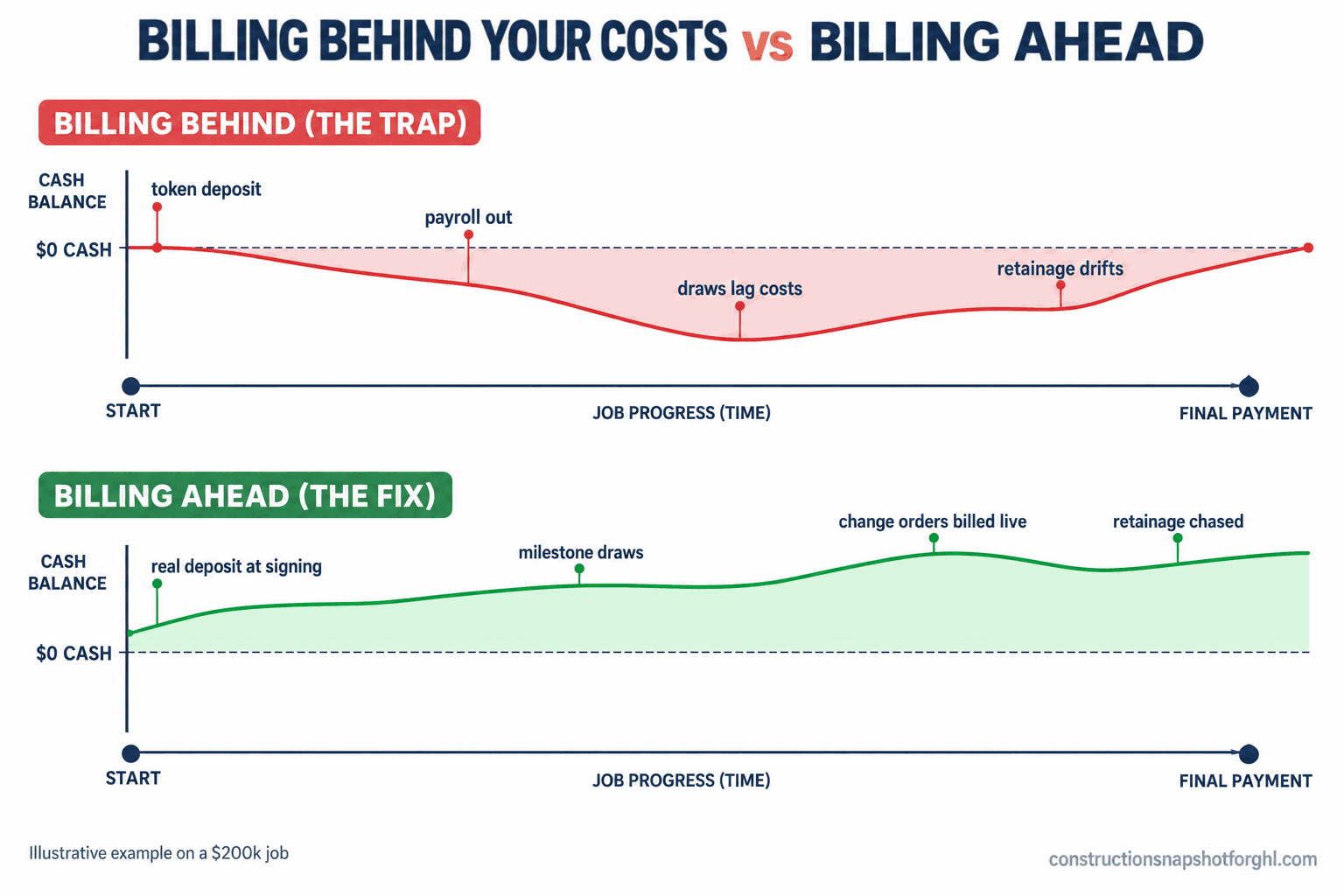
Here is the same idea in a table you can run against your own contracts. The left column is how most builders bill, and why it keeps them underwater. The right column is the version that keeps the account positive through the whole job.
Billing behind your costs vs billing ahead of your costs
| Feature | Billing behind cost (the trap) | Billing ahead of cost (the fix) |
|---|---|---|
| Deposit | Token deposit or none, you fund week one | Deposit sized to real early costs, written into the contract |
| Draws | Calendar-based or back-loaded, big money at the end | Milestone-based and front-weighted, requested the day the milestone hits |
| Change orders | Reconciled at closeout as a surprise bill | Priced, signed, and billed within 48 hours |
| Selections | Deadlines float, slow picks freeze the next draw | Hard selection dates tied to the draw calendar |
| Sub & supplier terms | Outflows lead inflows by 15+ days | Terms matched to your draw rhythm |
| Invoicing | Sent on the weekend, clock starts late | Sent same day, reminders on a schedule |
| Retainage | Drifts for months, nobody requests release | Dated release request at substantial completion |
Steal this: the money messages that get you paid
Most of the cash you are leaving on the table comes back with a handful of messages you keep meaning to send and never do on a busy week. Here is the exact wording, ready to use. Copy them, change the brackets, and put them to work on your next job.
These are not fancy. That is the point. The money you are losing is not lost to bad clients or a bad market. It is lost to a draw you forgot to request and an invoice that sat until Sunday. Put the messages on a schedule and the account stops dipping.
What the system looks like at three sizes
The seven stages are the same at every size. What changes is how much of it a human does and how much needs a system, because the cash-flow gap scales faster than you can track in your head.
The solo operator (roughly 6 to 10 jobs a year). You are the estimator, the project manager, and the person who sends invoices at 9pm. Your biggest risk is not the size of the gap, it is that billing is the thing that slips when the work gets busy. Start with the two highest-impact stages: a real deposit on every contract, and same-day draw requests. Keep a one-page draw schedule per job taped inside the binder or in your phone, and set a recurring calendar reminder to check unsent invoices every Friday. You do not need software yet. You need a rule that the draw request goes out before you leave the site on milestone day.
The mid-size shop (roughly 10 to 20 jobs, a small office team). Now you have two or three jobs running at once, which means two or three sets of early costs stacked on top of each other, and the gap is no longer something one person can hold in their head. This is where a system earns its keep. Standardize the draw schedule across every job, move invoicing and the day-7, day-14, day-21 follow-up onto automation so it fires without anyone remembering, and track retainage on a simple board so no release drifts. One person should own cash flow as a job, not as a thing they do between site visits. This is the size where our pipeline and workflow setup pays for itself, because the reminders run whether or not anyone is at a desk.
The larger builder (roughly 25 to 40 jobs, multiple crews). At this volume the gap is a six-figure number at any moment, and a single stage breaking down across a dozen jobs is a real cash crisis. You need the whole system running automatically and a weekly cash-flow review that looks at every job’s draw status, outstanding change orders, and retainage aging in one place. The messages above should be triggered by milestones in your system, not sent by hand. And you need a dashboard that answers one question every Monday: across all our jobs, how much have we earned that we have not yet collected, and what is the oldest piece of it. That number is your real cash-flow gap, and watching it is the difference between growth that funds itself and growth that eats your line of credit.
The through-line is the same at all three sizes. The small shop can run on discipline and a calendar reminder. The bigger you get, the more the discipline has to live in a system, because the gap grows faster than any one person’s memory.
The legal lines around deposits, liens, and retainage
Chasing cash harder is fine. Crossing a legal line to do it is not, and a few of these rules carry real teeth. None of this is legal advice, and the specifics vary by state, so confirm your own before you change a contract.
Deposits signed in the home have a cooling-off window. Under the FTC’s Cooling-Off Rule, a sale of more than $25 made at the buyer’s home gives the buyer three business days to cancel, and you have to give them written notice of that right (FTC). If you sign a remodel and take a deposit at the kitchen table, that window applies. Build the three-day right into your paperwork and your start date so a cancellation does not strand you with ordered materials and no recourse.
Lien rights depend on deadlines you can miss. Your mechanics lien is one of the strongest tools you have for getting paid, but in several states it depends on a preliminary notice sent early in the job. California and Arizona, for example, generally require a preliminary notice within 20 days of first furnishing labor or materials, and miss that window and you can weaken or lose your lien rights on that work (California CSLB). Other states require no such notice at all. Because the rule is so local, do not run a national preliminary-notice policy, run your state’s.
Retainage has its own state rules. How much can be held and how fast it must be released after completion is set by state law and your contract, not by whoever is slow to cut the check. Many states cap retainage in the 5 to 10 percent range and set a deadline for release after substantial completion (Knowify). Know your state’s cap and release clock, write them into the contract, and reference them in your release request so the holdback cannot drift indefinitely.
Common objections
“My clients will walk if I ask for a real deposit.” The good ones will not, and the deposit is how you find out which is which. A homeowner who refuses any deposit on a six-figure job is telling you something about how the rest of the payments will go. Frame it as a material and scheduling deposit, show them it comes off the total, and tie it to a start date they want. The deposit is not a trust test you are imposing on them. It is the thing that lets you order their materials without betting your own cash on whether they pay.
“I already run my jobs in a project-management tool, doesn’t that handle billing?” Sometimes, partly. A lot of builders have a tool that tracks schedules and documents but still send invoices by hand and never automate the follow-up, which is where the money actually leaks. The question is not whether you have software, it is whether the draw request goes out the day the milestone hits and whether a quiet client gets nudged on a schedule without you lifting a finger. If the answer is no, the tool is tracking your cash-flow gap, not closing it.
“I’m not technical, this sounds like a lot to set up.” The discipline version costs nothing and you can start Monday: a real deposit, same-day draw requests, and a Friday check of unsent invoices. The system version exists precisely so that a non-technical builder does not have to remember any of it, because the deposit link, the draw request, and the day-7, day-14, day-21 reminders are built once and then run on their own. You do not have to become a software person. You have to decide that billing is a job, then either do it on a rule or hand it to a system that does.
“Isn’t this just squeezing my clients?” No. Every piece of this is billing for work you have already done or are about to do, on terms you agreed to up front. Clear deposits, milestone draws they can see, change orders priced before the work, and a release request when the job is done are more transparent than the alternative, which is a vague percentage and a surprise bill at closeout. Clients do not resent a builder who bills clearly and on time. They resent the one who springs a number on them at the end.
Frequently asked questions
What is the difference between profit and cash flow in construction?
Profit is what a job earns over its whole life, revenue minus costs. Cash flow is how much money you actually have in the bank on a given day. A job can be profitable and still leave you short, because your costs (deposits, payroll, mobilization) go out early and your payments (draws, change orders, retainage) come back late. Closing that timing gap is what keeps a profitable job from draining your account.
How big should a construction deposit be?
Enough to cover your real up-front costs on that job, typically your long-lead material orders and first mobilization, so you are not funding week one out of your own pocket. Size it to the actual early spend, write it into the contract as a material and scheduling deposit, and confirm your state's rules, since some states cap deposits on residential home-improvement contracts.
Why am I always broke in the middle of a job even though it's profitable?
Because the money leaves before it comes back. Deposits to suppliers, payroll, and sub mobilization hit in the first weeks, while your draws lag the costs they cover and retainage sits until the end. Running two or three jobs at once stacks those early costs and widens the gap. The fix is front-loading cash with a real deposit and milestone draws that bill slightly ahead of spend.
What is retainage and why does it matter for cash flow?
Retainage is a portion of each progress payment, commonly 5 to 10 percent, held back until the whole project is finished and accepted. On a thin-margin job that holdback can equal or exceed your entire net profit, so letting it drift unrequested for months is the same as leaving your paycheck in the client's account. Treat it like any receivable with a dated release request at substantial completion.
How do I get clients to pay faster?
Send the invoice the same day the milestone is hit instead of the following weekend, tie each draw to a visible stage the client can see, and run an automatic follow-up on day 7, day 14, and day 21 for anything unpaid. Most slow payments are not refusals, they are invoices that sat unsent and reminders that never went out.
Does project-management software fix cash flow on its own?
Not usually. Most tools track schedules and documents well but still leave invoicing and follow-up to a human, which is exactly where cash leaks. What closes the gap is automation that sends the draw request the day a milestone hits and nudges a quiet client on a schedule, whether that lives in your current tool or a system like GoHighLevel.
Sources
- Rabbet, 2024 Construction Payments Report, on the cost and timing of slow payments in US construction (rabbet.com).
- Projul, Construction Accounts Receivable Guide, 2024, on construction days sales outstanding and payment timing (projul.com).
- Knowify, retainage guide, on standard retainage percentages and release (knowify.com).
- NAHB, state projections of remodeling activity, Q1 2026, on remodeling market size by state (nahb.org).
- Federal Trade Commission, the Cooling-Off Rule for sales made at a buyer’s home (consumer.ftc.gov).
- California Contractors State License Board, on licensing and preliminary notice requirements (cslb.ca.gov).