
The house is done. Not “done” done, but done. The kitchen works, the client moved the couch in last weekend, and your crew rolled off to the next job two weeks ago. There is a short list taped to the fridge: a cabinet door that catches, a paint touch-up on the stairwell, a missing cover plate, a window screen the supplier shorted you. Small stuff. A good half-day for one guy. And sitting on the other side of that half-day is the last payment plus retainage, which on this job is most of your profit. Three weeks later the list is still on the fridge, the money is still in the client’s account, and you are financing a finished project you cannot close.
Here is the short version. The last 10 percent of a build is where the money gets trapped, because the work feels finished so everyone stops treating it like a phase. Punch items drift, the client never formally signs off, the final invoice sits unwritten, and the retainage check nobody requested parks for months. The fix is to run closeout like any other stage of the job: a pre-punch walkthrough before you think you are done, one punch list in one place with photos, every item assigned to a sub or yourself with a date, a clean client sign-off that unlocks final payment, a final invoice and retainage release sent the same week, then lien waivers, warranty, and the review request. This post walks all six stages, hands you the exact closeout messages, and shows how it changes at three sizes of shop.
In this post
- Why the last 10 percent is where jobs go to die
- What a drifting closeout actually costs you
- The six stages of a closeout that actually ends
- Stage by stage: run closeout like a phase of the build
- Steal this: the closeout messages that get you paid
- What closeout looks like at three sizes
- The legal lines around final payment, lien waivers, and retainage
- Common objections
- Frequently asked questions
- Sources
Why the last 10 percent is where jobs go to die
Every builder knows the feeling. The job hits 90 percent and the energy drains out of it. The exciting work is done, the crew wants to be on the next project where the real money is, and the remaining items are small, annoying, and easy to put off. So they get put off. The problem is that the last 10 percent of the work is tied to the last and largest piece of the money, and the moment you stop treating closeout like a phase, the money stops moving too.
A build is a sequence of stages, and you run every one of them on purpose. You schedule rough-in, you call the inspector, you do not leave the framing “mostly done” and wander off. Closeout is the one stage almost nobody systematizes. It happens by accident, in the gaps between other jobs, driven by whoever remembers it. That is exactly why it drifts. There is no milestone, no inspection, no hard trigger that says the job is actually over and the final payment is now due.
The client feels the drift too, and it costs you more than money. A homeowner living in a finished house with a short list of open items does not think “small stuff.” They think “the contractor disappeared.” Every week an item sits open, your goodwill erodes, your odds of a five-star review drop, and the referral you were counting on gets quieter. The last impression is the one they tell their neighbor about, and right now the last impression is a cabinet door that still catches.
So the goal is simple. Give closeout a start, a sequence, and an end. Make it a phase with its own checklist and its own trigger for payment, the same way rough-in has an inspection. The next sections turn that into a six-stage system you can run on every job.
What a drifting closeout actually costs you
Slow money is not a minor annoyance in this trade, it is a structural feature of it, and closeout is where the slowness piles up. Rabbet’s 2024 Construction Payments Report estimated that slow payments cost the US construction industry around $280 billion in a single year, roughly 14 percent of all construction spending, and found that 82 percent of contractors were waiting more than 30 days to get paid, up sharply from 49 percent two years earlier (Rabbet, 2024). The 2025 edition put the figure even higher, at about $299 billion (Rabbet, 2025). When the whole industry runs on late money, the builder without a closeout system is the one absorbing the delay out of pocket.
The clock backs that up. Construction carries some of the longest days to get paid of any industry, with estimates for average days sales outstanding landing somewhere between 60 and 90 days once you count retainage, well above the roughly 60-day cross-industry average (Projul, 2024). A big part of that tail is the closeout window: the stretch between “the work is basically done” and “the final check and retainage have cleared.” That window is as long as your process lets it be.
The cost shows up three ways. First, it is your profit sitting still. Retainage is commonly 5 to 10 percent of the job held back from every payment until the whole project is accepted (Knowify), and on a thin-margin build that holdback can equal or exceed your entire net profit. A drifting closeout is not a cash-flow dent, it is your paycheck parked in someone else’s account. Second, it is the next job you cannot fund, because cash tied up in a finished project is cash you cannot use to mobilize the one after it. Third, it is reputation: the open punch list is the thing standing between you and the review and referral that bring in free work.
Share of US contractors reporting they wait more than 30 days to get paid, 2022 versus 2024 (Rabbet 2024 Construction Payments Report). The wait is getting longer across the industry, and the closeout stretch is a big part of it. Treat these as directional survey figures from a construction-finance vendor.
The point is not to scare you. It is to name the thing. If you have ever had a finished job you could not seem to close, you were not lazy and the client was not necessarily difficult. You were running closeout without a system. Here is one.
The six stages of a closeout that actually ends
Closeout is really a short sequence of events that each have to happen in order, and each one unlocks the next. Skip or blur any one of them and the whole thing stalls. Map the six stages, run them like a phase, and the job ends on a date instead of fading out over a month. Here are the six, and the next section works each one.
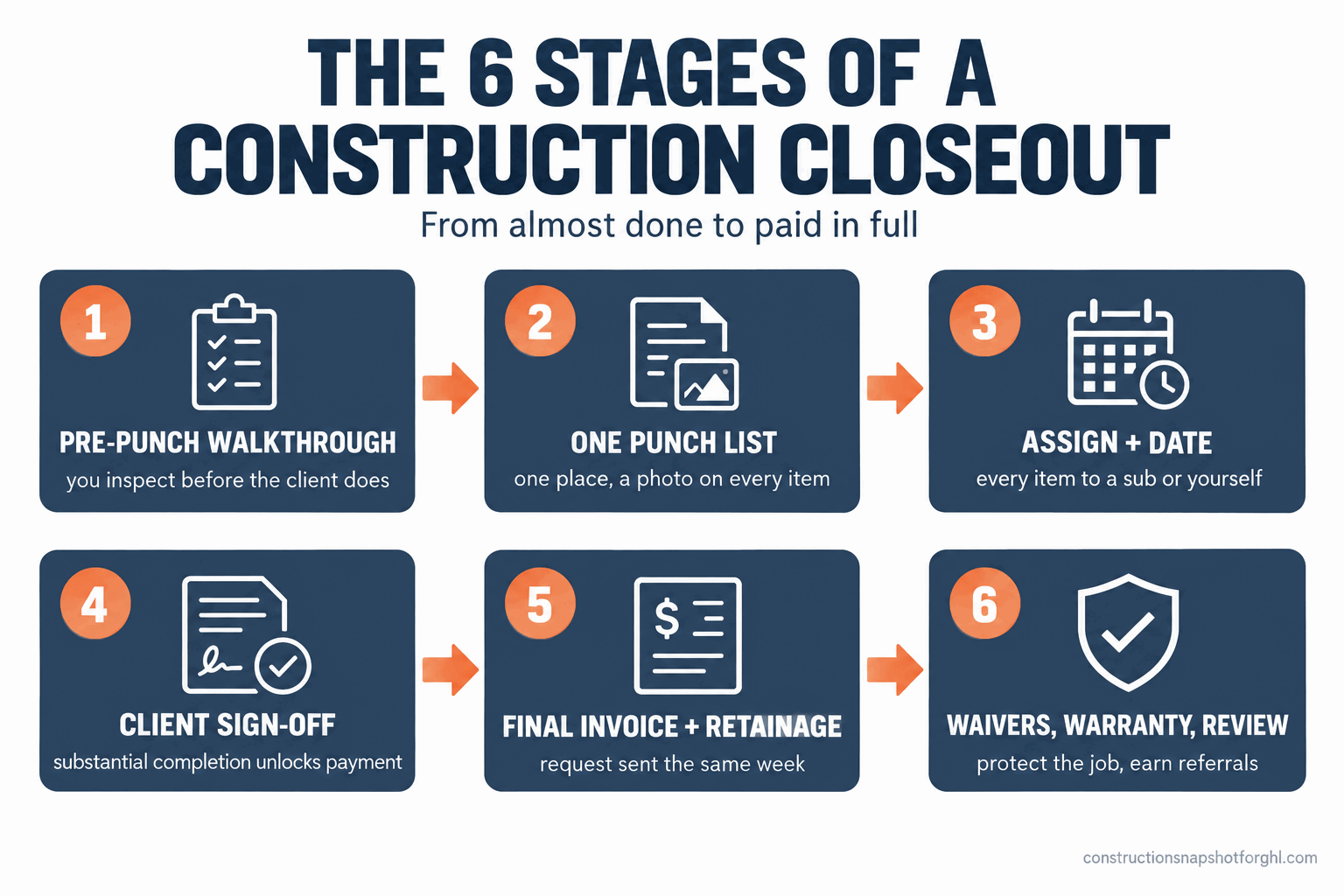
Think of it as a chain. Stages one through three are about finding and finishing the remaining work before it becomes a dispute. Stage four is the hinge: a formal sign-off that converts a finished-feeling job into a payable one. Stages five and six pull in the money and lock in the reputation. Most builders are strong at the actual work and leak at every one of these six points, because nobody ever taught them that closeout is its own job on the jobsite.
Stage by stage: run closeout like a phase of the build
Stage 1: The pre-punch walkthrough you run before the client does. The single biggest closeout mistake is letting the client create the punch list. When the homeowner walks the finished house with fresh eyes and a notepad, every nick and gap becomes evidence that the job is not done, and the list grows by the hour. Beat them to it. Walk the job yourself, or send your lead, with a critical eye a few days before you plan to call it done. Fix the obvious items before the client ever sees them. How it breaks: you skip your own walkthrough to save time, the client finds eleven things you would have caught in ten minutes, and now you are on the defensive and the list feels endless. The fix is a disciplined self-inspection first, so the list the client sees is short and mostly already handled, which changes the whole tone of the closeout from “what is still wrong” to “we are almost there.”
Stage 2: One punch list, in one place, with a photo on every item. Punch items die in the scatter. One is a text from the client, one is a note your lead wrote on a scrap, one is a voicemail from the painter, one is in your head. Nothing scattered ever gets fully closed, because no single place shows what is left. Capture every item in one list, each with a photo and a location, so there is no argument about what “the thing by the window” means. How it breaks: the list lives in three apps and two heads, items get missed, the client re-reports something you already fixed, and the whole thing feels like it is growing instead of shrinking. The fix is one shared list, ideally in a client portal or shared document the homeowner can see, where every item has a photo, a room, and a status. When the client can watch items flip to done, the anxiety drops and the “where are you” calls stop. A status rhythm does the same thing during the build, which we cover in the homeowner update cadence.
Stage 3: Assign every item to a sub or yourself, with a date. A punch list with no owner and no date is a wish list. Each item needs a name next to it and a day it will be done, whether that is your painter, your trim carpenter, or you. Then it needs to be scheduled like real work, not squeezed into the cracks of other jobs where it falls out. How it breaks: you batch all the punch items for “whenever I get a free afternoon,” that afternoon never comes because the next job is paying, and the list rolls week to week. The fix is to treat punch work as scheduled labor with assigned owners and hard dates, and to book the subs back while you still owe them money, which is before their final payment clears. A sub who is still owed money shows up for punch work. A sub who has been paid in full is a lot harder to get back, which is why sequencing matters, the same way it does when a sub no-shows mid-build.
Stage 4: The client sign-off that unlocks final payment. This is the hinge of the entire closeout, and the step builders skip most. A signed acknowledgment that the punch list is complete and the project has reached substantial completion is what converts a finished-feeling job into a job you are legally and practically owed the balance on. No sign-off, no trigger, and the money has no reason to move. How it breaks: you finish the last item, say “all set” in person, and move on, with nothing in writing that says the client agrees the work is done. Weeks later a new item surfaces, the client treats the whole job as still open, and your final payment is hostage to it. The fix is a short written sign-off at substantial completion, listing the punch items as closed, that you walk through with the client and both parties date. That document is the start of the final-payment clock, not the phone call you had on the driveway.
Stage 5: The final invoice and retainage release request, sent the same week. The day the sign-off is signed, the final invoice and the retainage release request go out. Same week, not “when I get to paperwork,” because every day the invoice sits unsent is a day added to the front of an already long wait. Bundle the balance and the retainage into one clear request tied to the signed completion document, so there is no ambiguity about what is owed or why. How it breaks: the job wraps, everyone moves on, and nobody formally requests the retainage, so it drifts for months until you notice the check never came. The fix is a same-day final invoice plus a dated retainage release request, with the same scheduled follow-up you would run on any other invoice, a friendly nudge on day 7, day 14, and day 21. The follow-up muscle here is identical to chasing a quiet estimate, which we break down in how to follow up on a construction estimate, and it is the same discipline that keeps the whole cash-flow gap from eating your year.
Stage 6: Lien waivers, warranty handoff, and the review request. The last stage is the one that protects you and grows the business. Trade the right lien waivers in the right order, hand over a clean warranty and closeout package (manuals, paint colors, warranty terms, a list of the subs who worked on the house), and then, and only then, ask for the review. How it breaks: you ask for the review while a punch item is still open, get silence or a lukewarm three stars, and skip the warranty handoff entirely, so six months later the client calls confused about a fixture they cannot find a manual for. The fix is to sequence it: close the work, sign off, collect final payment and the correct unconditional waiver once it clears, deliver the warranty package, then request the review at the moment the client is happiest. Done right, closeout is where your next three jobs come from. If you want the review half of this automated so it fires at the peak and routes unhappy clients to you first, our Google review system covers it.
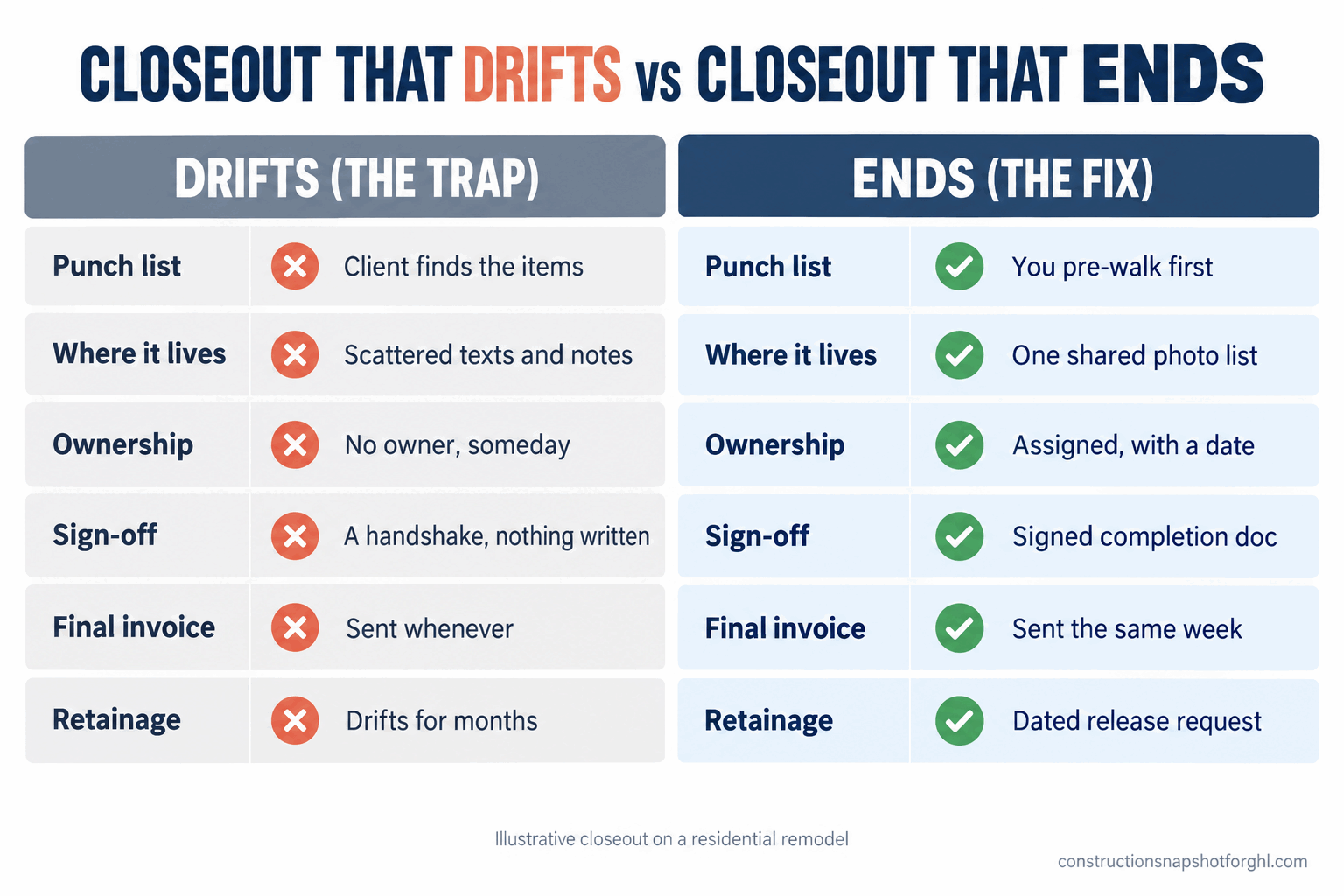
Here is the same contrast in a table you can run against your own last three jobs. The left column is how most closeouts actually go. The right column is the version that ends on a date and gets you paid.
Closeout that drifts vs closeout that ends
| Feature | Closeout that drifts (the trap) | Closeout that ends (the fix) |
|---|---|---|
| Punch list | Client finds the items, list grows by the hour | You pre-walk first, list is short and mostly handled |
| Where it lives | Scattered across texts, notes, and voicemails | One shared list, a photo and a date on every item |
| Ownership | No owner, done 'whenever I get a free afternoon' | Each item assigned to a sub or you, with a date |
| Sign-off | A handshake on the driveway, nothing written | Signed substantial-completion doc starts the clock |
| Final invoice | Sent whenever paperwork gets done | Sent the same week, with a reminder schedule |
| Retainage | Drifts for months, nobody requests release | Dated release request tied to the sign-off |
| Review | Asked while items are open, or never asked | Requested at the happiest moment, after handoff |
Steal this: the closeout messages that get you paid
Most of the money stuck in your finished jobs comes loose with a handful of messages you keep meaning to send. Here is the exact wording, ready to use. Copy them, change the brackets, and run them on your next closeout.
These are not clever. That is the point. The money stuck in your closed-out jobs is not lost to bad clients or a bad market. It is lost to a sign-off you never got in writing and an invoice that sat until the weekend. Put the messages on a sequence and the last payment stops drifting.
What closeout looks like at three sizes
The six stages are the same at every size. What changes is how much a human carries and how much needs a system, because closeout is the phase that slips first when you get busy, and the bigger you are, the more jobs are closing out at once.
The solo operator (roughly 6 to 10 jobs a year). You are the estimator, the project manager, and the person who writes the final invoice at 9pm. Your biggest closeout risk is not complexity, it is that the last 10 percent competes with the exciting start of the next job and loses. Start with the two highest-impact stages: the pre-punch walkthrough and the written sign-off. Keep a one-page closeout checklist per job in your binder or your phone, and set a standing rule that the final invoice goes out the same day the sign-off is signed. You do not need software yet. You need a rule that closeout is a scheduled half-day, not a someday.
The mid-size shop (roughly 10 to 20 jobs, a small office team). Now you have two or three jobs closing out around the same time, and the punch items for all of them blur together. This is where a system earns its keep. Standardize one punch-list template and one sign-off document across every job, put the shared list in a client portal so homeowners stop calling for status, and move the final invoice and the day 7, day 14, day 21 retainage follow-up onto automation so it fires without anyone remembering. One person should own closeout as a defined job. This is the size where our workflow automation setup pays for itself, because the reminders and the review request run whether or not anyone is at a desk.
The larger builder (roughly 25 to 40 jobs, multiple crews). At this volume several jobs are always in closeout, and a stalled sign-off across a handful of them is a six-figure number sitting still. You need the whole sequence running automatically and a weekly closeout review that looks at every job’s punch status, sign-off status, final invoice, and retainage aging in one place. The messages above should be triggered by milestones in your system, not sent by hand. And you need a dashboard that answers one question every Monday: across all our jobs, how many are substantially complete but not yet paid in full, and what is the oldest piece of it. That number is your real closeout gap, and watching it is the difference between finishing jobs and merely stopping work on them.
The through-line is the same at all three sizes. The small shop can run closeout on discipline and a checklist. The bigger you get, the more that discipline has to live in a system, because the number of jobs drifting at once grows faster than anyone’s memory.
The legal lines around final payment, lien waivers, and retainage
Chasing your final payment hard is fine. Crossing a legal line to do it, or signing away your rights to get it faster, is not. A few of these rules carry real teeth, and they vary a lot by state. None of this is legal advice, so confirm your own state’s version before you change a contract or sign a waiver.
Know your lien waivers, and the order you sign them. A conditional waiver only takes effect once the payment actually clears, so you keep your lien rights if the check bounces or never comes. An unconditional waiver takes effect the moment you sign it, paid or not. The rule of thumb from payment specialists is simple: sign conditional waivers before payment, and sign an unconditional waiver only after the money, including retainage, has fully cleared your bank (Corpay lien waiver guide). An unconditional final waiver is the riskiest document in closeout, because it releases every lien right on the whole project immediately, so never hand one over on the promise of a check. Several states, including California, Texas, Arizona, Nevada, and Florida, also mandate specific statutory waiver language, and a waiver that deviates from the required form in those states may be unenforceable.
Retainage has a release clock, and it is set by law, not by whoever is slow to pay. In California, for example, an owner on a private project generally must release withheld retention within 45 days after the date of completion, and the prime contractor must pass each subcontractor’s share along within 10 days of receiving it (Cal. Civ. Code §8812 and §8814). Other states set their own windows, and public work often runs on a different, longer clock. Because the rule is so local, do not run a national retainage policy, run your state’s, write the deadline into your contract, and reference it in your release request so the holdback cannot drift indefinitely.
Final completion is a document, not a vibe. The reason the sign-off in Stage 4 matters legally is that “substantial completion” and “final completion” are defined moments that trigger payment and start warranty and lien clocks. Standard industry contracts treat them as formal milestones for exactly that reason. Getting the client to date a completion document is not bureaucracy, it is the thing that makes your final payment collectible and your deadlines enforceable.
Common objections
“My clients will think a sign-off form is me not trusting them.” Framed right, it is the opposite. The sign-off is you confirming, in writing, that you finished everything you promised, and giving them a clear record of it. Present it as “here is proof every item is done, for your records and mine,” not “sign here so I can bill you.” The clients who balk at acknowledging that completed work is complete are telling you something useful about how the final payment was going to go anyway.
“I already run my jobs in a project-management tool, doesn’t that handle closeout?” Sometimes, partly. Plenty of builders have a tool that tracks the schedule and stores documents but still manage punch items in their head and send the final invoice by hand. The question is not whether you own software, it is whether every punch item has an owner and a date, whether the client signs off in one place, and whether the retainage request goes out the same week with automatic follow-up. If the answer is no, the tool is storing your closeout, not closing it.
“The punch items are tiny, it feels silly to make a whole process out of them.” The items are tiny. The money attached to them is not. A half-day of punch work is often standing in front of the last 5 to 10 percent of a six-figure job, which is most of your profit. A process is not about the size of the cabinet door, it is about not letting the cabinet door hold your paycheck for a month. Small work, large money, which is exactly when a system is worth it.
“I’m not technical, this sounds like a lot to set up.” The discipline version costs nothing and you can start on your next job: a pre-punch walkthrough, one photo list, a written sign-off, and a same-week final invoice. The system version exists precisely so a non-technical builder does not have to remember any of it, because the walkthrough invite, the shared list, the sign-off, and the retainage follow-up are built once and then run on their own. You do not have to become a software person. You have to decide closeout is a phase, then either run it on a checklist or hand it to a system that runs it for you.
Frequently asked questions
What is a construction punch list?
A punch list is the list of small items left to finish or correct before a construction project is considered complete, such as touch-up paint, a sticking door, a missing cover plate, or a short-shipped part. It is created near the end of the job, usually from a walkthrough, and every item should have a location, ideally a photo, an assigned owner, and a target date. Closing the punch list is what lets you get the client to sign off and release final payment and retainage.
When should I create the punch list, before or after the client walkthrough?
Run your own pre-punch walkthrough first, a few days before you plan to call the job done, and fix the obvious items. Then do the formal walkthrough with the client. If you let the client create the list cold, every small flaw becomes evidence the job is unfinished and the list grows. Beating them to it keeps the list short and changes the tone from 'what is still wrong' to 'we are almost there.'
How do I get a client to pay the final invoice and release retainage?
Get a written substantial-completion sign-off that lists the punch items as closed and have the client date it. That document is the trigger. Send the final invoice and the retainage release request the same week, tied to the signed completion, with a secure payment link, and run an automatic follow-up on day 7, day 14, and day 21. Most late final payments are not refusals, they are invoices that sat unsent and a sign-off that never happened in writing.
What is retainage and why does it get stuck at closeout?
Retainage is a portion of each payment, commonly 5 to 10 percent, held back until the whole project is finished and accepted. It gets stuck because closeout has no built-in trigger: once the work feels done, nobody formally requests the release, so it drifts for months. The fix is to treat it like any other receivable with a dated release request tied to the completion sign-off. In some states a release deadline is set by law, for example 45 days on private projects in California.
Should I sign a lien waiver before I get final payment?
Sign a conditional waiver before payment if one is required, because it only takes effect once the payment clears, so your lien rights survive if the check fails. Never sign an unconditional final waiver until the full final payment and retainage have cleared your bank, because an unconditional waiver releases your lien rights immediately whether or not you are paid. Several states also require specific statutory waiver language, so use the correct form for your state.
Why does closeout hurt my reviews and referrals?
A homeowner living in a finished house with open punch items does not think the work is small, they think the contractor disappeared. That last impression is the one they share with neighbors. If you ask for a review while items are open, you get silence or a lukewarm rating. Close the work, hand over a warranty package, then ask for the review at the moment the client is happiest, and closeout becomes your best source of free referral work.
Sources
- Rabbet, 2024 Construction Payments Report, on the cost and timing of slow payments in US construction (rabbet.com).
- Rabbet, 2025 Construction Payments Report, on the updated cost of slow payments (rabbet.com).
- Projul, Construction Accounts Receivable Guide, 2024, on construction days sales outstanding and payment timing (projul.com).
- Knowify, retainage guide, on standard retainage percentages and release (knowify.com).
- Corpay, construction lien waivers guide, on conditional versus unconditional waivers and final-payment waivers (corpay.com).
- California Civil Code, sections 8812 and 8814, on retention release deadlines on private projects (leginfo.legislature.ca.gov).