
It is a Tuesday night and you are at the kitchen table writing your fourth estimate of the week. You are busier than you have ever been. The phone rings, the inbox fills, the walkthroughs stack up on the calendar. And yet when you add up the quarter, the number that matters is going the wrong way. You are sending more bids than you did two years ago and signing a smaller slice of them. More work, less work won. If that gap is eating at you, you are not imagining it, and you are not bad at your job. You have a leak in the path between the first phone call and the signed contract, and bidding harder only pours more water through it.
Here is the short version. Your close rate is not falling because your prices are too high or because the market turned on you. It falls because volume hides a broken process. A construction bid dies in six predictable places: you quote everyone who calls instead of qualifying, you answer too slow and lose to whoever called back first, your walkthrough has no structure so the scope stays fuzzy, your estimate takes two weeks to land, you send a bare number instead of a proposal, and you never follow up after you hit send. Each one drops a few points off your win rate. Fix the path and the same number of leads turns into more signed jobs, without writing a single extra estimate. This post walks all six, gives you the exact scripts that move a bid to a signature, and shows how the fix changes depending on your size.
In this post
- The number you stopped watching: bids out vs jobs won
- The six places a bid dies between the call and the contract
- Run the bid-to-close audit on your last ten bids
- Steal this: the scripts that move a bid to a signature
- What the system looks like at three sizes
- The legal lines you cannot cross while chasing bids
- Common objections
- Frequently asked questions
- Sources
The number you stopped watching: bids out vs jobs won
Most builders track revenue and backlog. Almost nobody tracks the one ratio that predicts both: bids sent divided by jobs won. Call it your bid-to-close ratio, or your hit rate. It is the single cleanest read on whether your sales process is working, and it is the number that quietly slides while you are too busy to notice.
Here is the rule of thumb the bidding-data people use. ConstructConnect, which sits on top of a huge pile of commercial bid activity, pegs a healthy hit ratio for commercial general contractors at roughly 25 percent, about one win for every four bids, with competitive private work landing in the 15 to 25 percent range and hard-bid public work lower (ConstructConnect). Treat that as directional trade guidance rather than a surveyed law, but the shape is right, and it matches what homeowners are told to do. Angi and most consumer advice sites push buyers to collect three or four bids before they hire (Angi). Do the math on that. If every homeowner is talking to four builders, then one in four is the water line. Beating it is a process advantage, not luck.
Now picture what volume does to that ratio. Two years ago you wrote 40 bids and won 14, a 35 percent hit rate, because you knew every lead and chased every one personally. This year you are flooded, so you write 90 bids and win 20. Revenue is up, you feel maxed out, and you tell yourself business is good. But your hit rate just fell to 22 percent. You are doing far more estimating work for a smaller share of wins, which means your cost to win a job went up and your margin on everything went down, because the hours you burn on bids that die are overhead your live jobs have to carry. That is the trap. More bids feels like progress right up until you divide.
The reason the ratio falls under volume is not mysterious. When you are slammed, the parts of the process that depend on you remembering are the first to break. You answer the ninth lead of the day slower than the first, the estimate sits for ten days because you are on a jobsite, and the follow-up never happens because you already moved on. Those are capacity problems, not skill problems, and you cannot out-hustle them. You have to build a path that does not depend on your memory on a bad week.
The six places a bid dies between the call and the contract
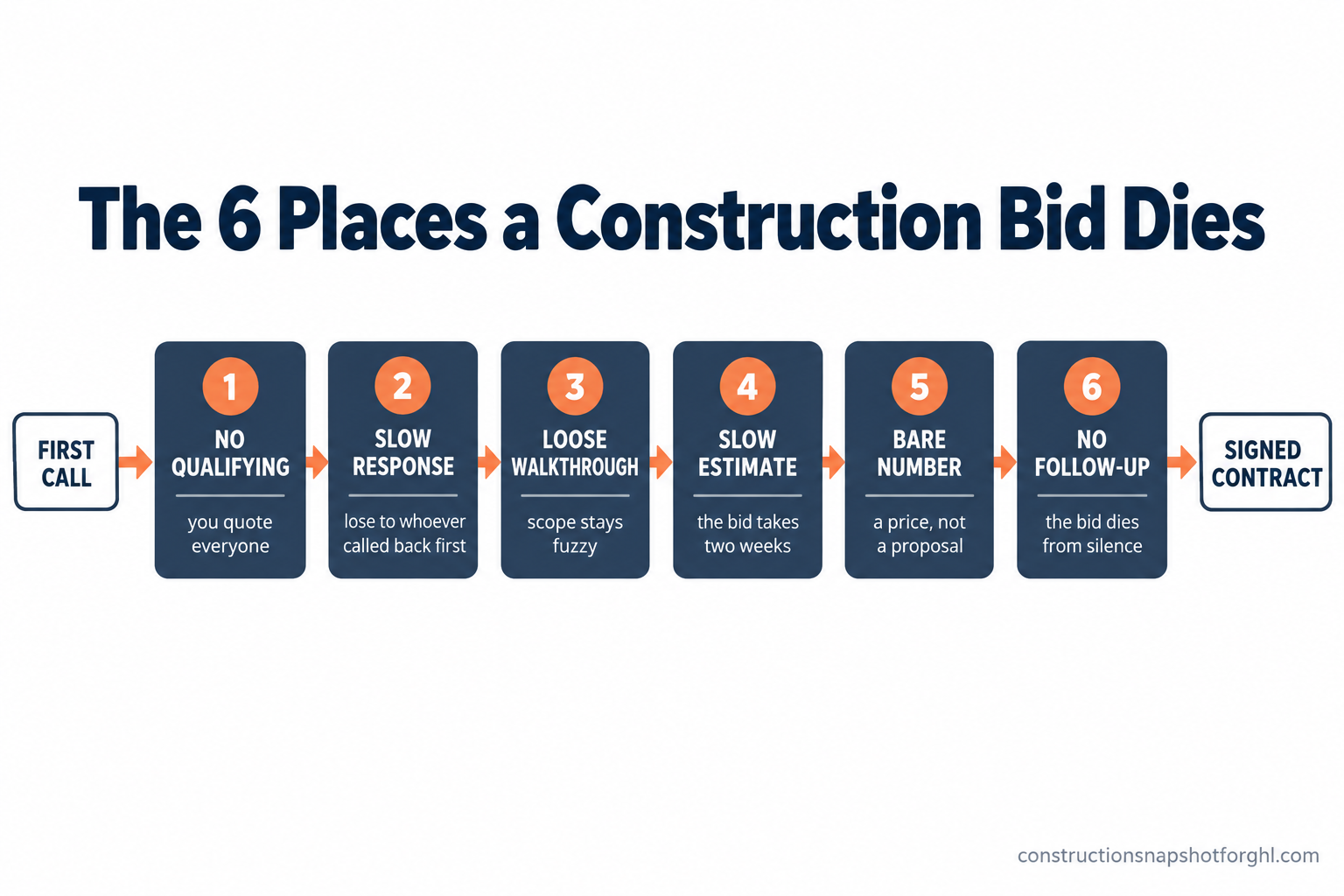
Here they are, in the order they hit a lead. Each one has a way it hides, which is why you feel busy and still watch the ratio fall.
Stage 1: You quote everyone who calls. When the phone is ringing it is easier to say yes to every lead than to ask three hard questions first. So you drive across town to measure a job for someone with no budget, no timeline, and three other builders already in the door. The bid never had a chance, and it still cost you an afternoon and an evening of estimating. Where it hides: a dead bid feels free because you do not track estimating hours, so a low close rate on unqualified leads looks like bad luck instead of a filtering problem. The fix is a short qualifying conversation before you commit to a site visit: budget range, timeline, whether they are getting other bids, and whether both decision-makers will be there. Disqualifying a bad lead in five minutes on the phone is the highest-return thing you will do all week.
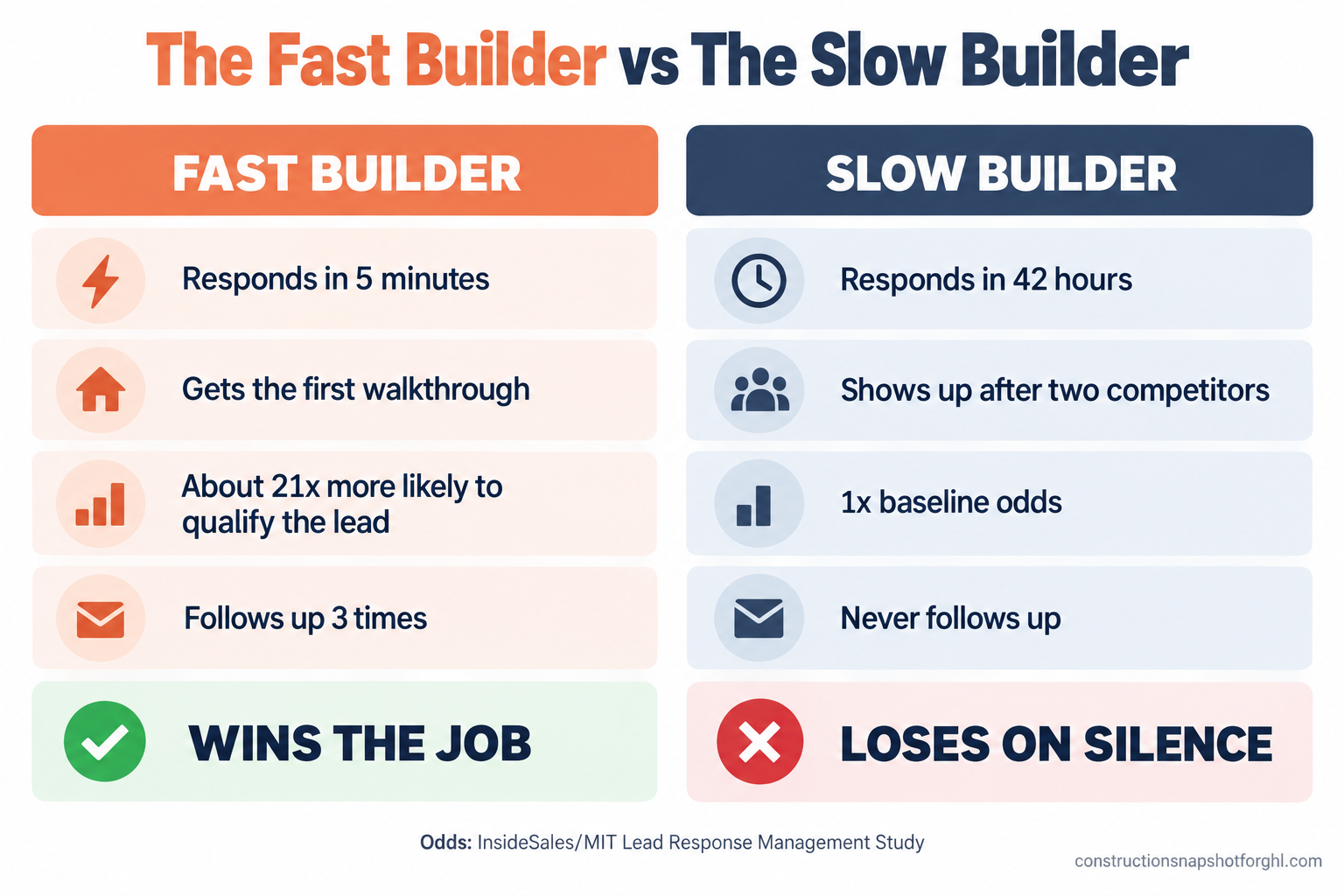
Stage 2: You answer too slow, and the fastest builder already won. This is the biggest lever and the one almost everyone underuses. Speed to first contact decides a shocking share of jobs, because the homeowner who filled out your form filled out three others at the same time, and attention fades by the minute. The research is blunt. A long-running analysis of 15,000-plus leads found that contacting a web lead within five minutes instead of thirty made a company about 21 times more likely to qualify it, and roughly 100 times more likely to actually connect (InsideSales/MIT Lead Response Management Study). Harvard Business Review audited 2,241 U.S. companies and found that responding within an hour made you nearly 7 times more likely to have a meaningful conversation with a decision-maker, yet the average first response took 42 hours and 23 percent of companies never responded at all (HBR). Where it hides: you think you respond fast because you call back “that day,” but that day is often six hours later, after the homeowner already booked a walkthrough with the guy who texted back in two minutes. The fix is an instant response the moment a lead comes in, even if it is just a text that says you got it and asks one scheduling question.
Relative odds of qualifying a web lead by how fast you respond, from the InsideSales/MIT Lead Response Management Study of 15,000-plus leads (source). Waiting 30 minutes instead of 5 is not a small penalty. It is most of your odds, gone.
Stage 3: The walkthrough has no structure, so the scope stays fuzzy. You show up, you chat, you take a few photos, you say you will put some numbers together. Then you get home and realize you never pinned down the budget, the decision process, or the must-haves versus nice-to-haves. So your estimate is built on guesses, and a guessed estimate is either too high (you lose) or too low (you win and bleed). Where it hides: a friendly walkthrough feels productive, so you never notice you left without what you needed to price it right. The fix is a one-page walkthrough checklist you run every time: scope, existing conditions, budget, timeline, decision process, and the photos and measurements that let you price without a second trip.
Stage 4: The estimate takes two weeks to come back. Momentum is a real thing in sales, and it is almost always working against you. The day after the walkthrough the client is excited and leaning your way. Ten days later they have cooled off, gotten two faster bids, and half-forgotten the conversation that made them like you. Slow estimates do not just lose on speed, they lose the warmth you built in person. Where it hides: the estimate feels like the hard part, so taking your time feels responsible, when in fact the delay is quietly handing the job to a faster competitor. The fix is a turnaround target you actually hold, 48 to 72 hours for a standard bid, built from templated line items and real cost data so you are not rebuilding every quote from scratch.
Stage 5: You send a price, not a proposal. A bare number invites one comparison: yours against the other three, lowest wins. A proposal that shows scope, inclusions, exclusions, a timeline, your license and insurance, and a line or two about how you run a job changes the conversation from price to value. Same number, completely different odds, because now the client is comparing builders, not just dollars. Where it hides: a number is faster to send, so you send a number, and then you cannot understand why you keep losing to a guy who is more expensive. The fix is a proposal template that makes your bid look like the professional one in the pile, every time, without extra work per job.
Stage 6: You never follow up, and the bid dies of silence. This is the quiet killer. You send the estimate, you hear nothing, and you tell yourself they went with someone else. Usually they did not. They got busy, the project slipped a few weeks, your email got buried, and nobody ever circled back. The job was winnable and it died because the follow-up that would have closed it never happened. Where it hides: no answer feels like a no, so you write it off instead of chasing it. It is not a no. The fix is a scheduled follow-up sequence that runs after every estimate, which we break down step by step in our guide to following up on a construction estimate, because this one stage is where most of your lost win rate actually lives.
Run the bid-to-close audit on your last ten bids
You do not need a CRM to find your leaks. Pull your last ten estimates, the ones you lost and the ones you won, and answer six questions about each. The pattern will tell you exactly which stage is bleeding.
The six-question bid-to-close audit (run it on your last ten estimates)
| Feature | Ask yourself | If the answer is bad, the stage that is leaking is |
|---|---|---|
| Qualifying | Did you qualify budget, timeline, and decision process before the site visit? | Stage 1: you are quoting unqualified leads. Ask three questions first. |
| Speed | How many minutes passed before the lead got a real response from you? | Stage 2: slow response. An instant text-back buys back the most odds. |
| Scope | Did you leave the walkthrough with everything you needed to price it right? | Stage 3: loose scope. Run a one-page walkthrough checklist every time. |
| Turnaround | How many days did the estimate sit before it reached the client? | Stage 4: slow estimate. Hold a 48 to 72 hour turnaround target. |
| Presentation | Did you send a full proposal, or just a price? | Stage 5: bare number. Use a proposal template that sells value. |
| Follow-up | How many times did you follow up after sending the estimate? | Stage 6: no follow-up. Run a scheduled sequence on every bid. |
The point of the audit is not to feel bad about the jobs you lost. It is to find the one or two stages costing you the most, because they are rarely the ones you blame. Most builders blame price. When they actually walk their last ten bids, the real holes are almost always speed and follow-up, both of which are process problems you can fix without dropping a single number.
One more reason to tighten the path: the market is not going to carry you. There are about 128,000 remodeling firms in the US as of early 2025, up from 69,000 in 2000, and the national remodeling market is near $279 billion, with California, Texas, and Florida alone driving more than a fifth of it (NAHB). At the same time, Harvard’s remodeling indicator projects homeowner improvement spending reaching roughly $522 billion by the end of 2026, but with growth cooling from 2.9 percent to 1.6 percent across the year (JCHS via Qualified Remodeler). More firms competing, demand still growing but slowing down. In that market the builder who answers first and follows up wins the jobs the disorganized competitor lets die on the vine.
Annual remodeling activity by state, in billions of dollars, from NAHB’s 2026 state projections (source). These three states alone are more than 20 percent of a roughly $279 billion national market, and every dollar of it is a four-horse race.
Steal this: the scripts that move a bid to a signature
Most of the win rate you are losing comes back with a handful of messages you keep meaning to send and never do on a busy week. Here is the exact wording, ready to use. Copy them, change the brackets, and put them to work on your next lead.
Sending these by hand works right up until the week you are slammed, which is exactly the week your win rate falls. The smarter move is to trigger the instant response, the estimate-delivery note, and the three-touch follow-up off the lead’s stage in a construction sales pipeline so they never depend on you remembering, the same speed-to-lead discipline behind missed-call text-back and why the fastest responder wins the job.
What the system looks like at three sizes
How you build this path depends on how big you are, because who is dropping the ball changes with scale.
The solo operator or small remodeler (6 to 12 jobs a year). You are the estimator, the project manager, and the person on the roof, so the stages that leak are the ones that need you at a desk. You answer the fifth lead of the day slow, and the follow-up never happens because you are framing a wall. Your highest-return fix is automating the two stages that depend on your memory: the instant response and the follow-up sequence. Qualify hard on the phone so you only drive out for real jobs, hold a 72-hour estimate turnaround, and let the follow-up run itself. You cannot out-work a low hit rate. You buy back the easy points with a system that fires without you.
The mid-size design-build or remodeling firm (15 to 25 jobs). Now the problem is that every person who touches a bid runs the process differently. One estimator qualifies, another does not. One follows up twice, another never does. The win rate swings wildly depending on who caught the lead. This is the tier where standardizing pays the most. Put every lead into one sales pipeline with the same stages, the same instant response, the same proposal template, and the same follow-up cadence, so the job you win does not depend on who answered the phone. This is also where the right CRM for your shop matters, because the tool only helps if the process behind it is consistent.
The larger custom builder (30 to 40 jobs). At this scale the risk shifts from “I forgot” to “our pipeline is inconsistent across three estimators and a dozen open bids.” A single point of win rate across 120 bids a year is serious money, so the leak controls become a documented standard: a qualifying script everyone uses, a speed-to-lead target with a hard clock, an identical proposal format, and a follow-up sequence that runs automatically and gets reported on weekly. If chasing the follow-up is the bottleneck, a trained GHL virtual assistant can own the cadence so no bid goes cold waiting for someone to remember it.
The legal lines you cannot cross while chasing bids
Speeding up and automating your bid process touches a few rules, and getting them wrong turns a sales win into a liability. This is not legal advice, and the rules vary by state, so confirm yours before you finalize a template.
Your license number belongs in your advertising. In California, your CSLB license number is required in your contracts and in all advertising, which includes your website, your proposals, and arguably the texts and emails you send (California BPC 7030.5). If you are automating outreach, make sure the license number rides along in the signature. Several states have their own versions of this rule, and the threshold for needing a license at all rose in California to work of $1,000 or more, up from the old $500 line many contractors still quote.
Automated texts need consent. The follow-up sequences in this post are a great idea and a compliance obligation at the same time. Under the TCPA, you need the contact’s consent before you send automated marketing texts, and you have to honor an opt-out (FCC on TCPA). In practice that means a clear opt-in on your lead form and a working STOP in every sequence. A lead who filled out your form asking for a quote has given you a reason to text, but keep the consent language clean and the opt-out real.
In-home closes come with a cancellation window. If you sign a contract or a significant upgrade at the client’s kitchen table, the FTC Cooling-Off Rule gives the buyer three business days to cancel most sales of $25 or more made there (FTC). Fast closing is good. Know the clock exists and provide the required notice so a signature does not unwind on you three days later.
Common objections
“My close rate is fine, this is for guys who do not know how to sell.” Maybe. Run the six-question audit on your last ten bids anyway. If every one was qualified, answered in minutes, scoped on a checklist, turned around in three days, presented as a full proposal, and followed up three times, then you are already running the system and you have lost ten minutes. If even half of them missed two of those, you just found the points you have been leaving on the table. The builders with the best hit rates are rarely the cheapest. They lose the fewest winnable jobs to slow responses and silence.
“I do not want to be the pushy contractor who texts people five times.” Following up is not pushing, it is service. The homeowner asked you for a quote, which is an invitation to stay in touch about it. A friendly check-in that offers to adjust scope or hold a start date is genuinely helpful, and the breakup message at the end gives them a graceful exit if they are out. Pushy is calling angry after one day of silence. A scheduled, useful sequence over ten days is just doing the part of the job most of your competitors are too disorganized to do.
“I already pay for Buildertrend or JobTread, does that not handle this?” Your project-management tool is built to run the job after you win it: schedules, selections, change orders, invoices. It is not built to answer a brand-new lead in five minutes or to chase an unsigned estimate on a cadence. Those are front-of-funnel sales jobs, and most construction PM platforms barely touch them. The leak is almost never a missing feature. It is the human follow-up that never happens, which is a workflow problem, not a storage one. It is worth being honest about what your current tool actually covers, which is the whole point of our construction lead conversion breakdown.
“Automating all this sounds like a big project I do not have time for.” It is less work than what you are doing now, moved earlier and made automatic. The hour you spend once to set up an instant-response text and a follow-up sequence is a fraction of the time you burn driving to unqualified walkthroughs and the margin you lose on jobs that died from silence. Automated, the bid-to-close path is the cheapest sales rep you will ever hire, and it never forgets to follow up.
Where to start this week
Do not rebuild the whole path at once. Pull your last ten bids and run the six-question audit tonight, find the one stage bleeding the most, and fix only that this week. For most builders that means two moves: an instant text-back so no lead waits hours for a first response, and three follow-up messages on a schedule so no estimate dies in silence. Those two usually move a win rate more than any price cut, because they win back jobs you were already going to lose for free. The part that depends on someone remembering, the instant answer and the chase after the estimate, is exactly what the Construction Snapshot for GoHighLevel automates, so the message that wins the job goes out whether or not you are at a desk.
Frequently asked questions
Why am I bidding more but winning fewer jobs?
Because volume hides a broken sales process. When you are busy, the parts of the path that depend on you remembering break first: you answer new leads slower, your estimates sit longer, and you stop following up. Each of those drops a few points off your win rate, so writing more bids pours more leads through the same leaks. The fix is not bidding harder or dropping your price. It is tightening the six stages between the first call and the signed contract, especially speed of response and follow-up, so the same number of leads converts at a higher rate.
What is a good bid-to-close ratio for a contractor?
As a rough industry rule of thumb, ConstructConnect puts a healthy bid-hit ratio for commercial general contractors around 25 percent, roughly one win for every four bids, with competitive private work in the 15 to 25 percent range and hard-bid public work lower. That lines up with the fact that homeowners are commonly advised to collect three or four bids before hiring, so you are usually in a four-way race. Treat 25 percent as the baseline to beat, not a ceiling. Builders who answer fast and follow up consistently routinely run well above it on the leads they choose to chase.
How fast do I really need to respond to a new lead?
Within minutes, not hours. An analysis of more than 15,000 leads found that contacting a web lead within five minutes instead of thirty made a company about 21 times more likely to qualify it and roughly 100 times more likely to connect. Harvard Business Review found that responding within an hour made you nearly 7 times more likely to reach a decision-maker, yet the average company took 42 hours and 23 percent never responded at all. The homeowner who contacted you also contacted several competitors, so the first builder to respond has a large and measurable advantage.
Where do most construction bids actually get lost?
In two places most builders do not track: speed of first response and follow-up after the estimate. A slow first response hands the job to whoever called back sooner, often before you even get a walkthrough. And most sent estimates that go quiet were not lost to a competitor or a decision, they were lost because nobody ever circled back. A homeowner who goes silent is usually busy or delayed, not gone. A scheduled follow-up sequence recovers a large share of those jobs, which is why it is the single highest-return fix for most shops.
Should I just lower my prices to win more bids?
Usually not. Lowering your price wins the wrong jobs at the wrong margin and does nothing to fix the real leaks, which are process problems. If you are losing bids on speed and silence, a lower number just means you lose the same jobs for less money or win them and bleed. Send a full proposal that shows scope, inclusions, exclusions, timeline, and your license and insurance so the client compares builders rather than just dollars, respond fast, and follow up. Those moves lift your win rate without touching your margin.
Do I need software to improve my close rate?
No, but it makes consistency possible at volume. You can improve your win rate by hand: qualify on the phone before you drive out, respond to every lead within minutes, scope on a one-page checklist, turn estimates around in two to three days, send a proposal instead of a bare number, and follow up three times on a schedule. The problem is that doing all six by hand breaks the week you get busy, which is exactly when it matters most. Automating the instant response and the follow-up sequence off your pipeline stages is what keeps the system running when you cannot.
Is it pushy to follow up multiple times after sending an estimate?
No, as long as the follow-up is helpful and spaced out. The homeowner asked you for a quote, so checking in about it is service, not pressure. A good sequence offers something useful each time, like adjusting the scope to hit a budget or holding a start date, and ends with a clean breakup message that gives the client an easy out if they have moved on. That last message often restarts a conversation that had simply stalled. Pushy is one angry call after a day of silence. A scheduled, courteous sequence over about ten days is just finishing the job most competitors never do.
Sources
- InsideSales/MIT Lead Response Management Study (5 min vs 30 min: ~21x qualify, ~100x connect)
- Harvard Business Review: The Short Life of Online Sales Leads (7x within an hour; 42-hour average; 23% never respond)
- ConstructConnect: bid-hit ratios for commercial GCs (~25%, about 1 win in 4 bids)
- Angi: how construction bidding works (homeowners collect 3 to 4 bids)
- NAHB: Three states drive over 20% of remodeling activity (128,000 firms; CA, TX, FL market sizes)
- JCHS Leading Indicator of Remodeling Activity (~$522B by end of 2026; growth 2.9% to 1.6%), via Qualified Remodeler
- California BPC 7030.5 (license number required in advertising and contracts)
- FCC: Telemarketing and robocall rules (TCPA consent for automated texts)
- FTC: Cooling-Off Rule for sales made at the buyer’s home (3-day cancellation window)